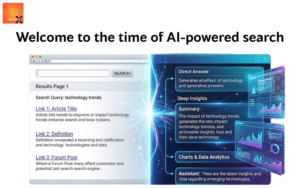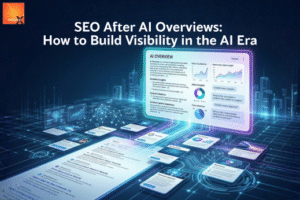
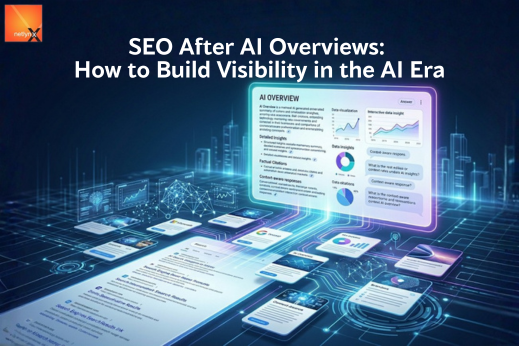
From Google’s AI Overviews to conversation-driven search features and answer-focused interfaces, everything about search has evolved beyond recognition. Rather than going through a list of ten blue links, users get summaries, AI recommendations, and follow-ups directly on the search engine interface.
And for businesses, this development couldn’t be more important.
Companies whose websites have been receiving large amounts of information-seeking traffic can expect their CTRs to change due to the shift. On the other hand, brands adopting new SEO techniques will find new ways to build authority and trust in AI-assisted search results.
And that’s when AI visibility on search will become one of the key objectives for SEO in 2026.
Modern SEO is no longer just about rankings. It requires businesses to develop strategies for securing citations in AI summaries, being featured in conversational searches, being recognised by entity recognition, and ensuring relevance in answer engines. The debates regarding AI and SEO have moved from theory into practice.
Terms such as AI search ranking optimization, AI crawlers optimization, GEO, and AEO have become core to the process described above. The discussion on which marketing strategy is more efficient – GEO, SEO, or AEO – is going to continue as search moves beyond ranking algorithms.
The businesses dominating in 2026 will not be just those ranked highly. They will be the sources AI will rely on
The Impact of Google AI Overviews on SEO
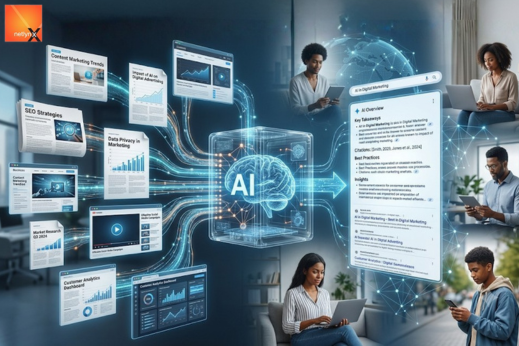
Google AI Overviews are now a key element of Google searches across various industries in 2026. From something that was just a test to something that has become a significant part of the search process.
When looking up information, Google provides AI overviews that summarize what other sites say on the same topic and, as a result, often eliminate the need to click external links to find the information.
It has influenced how SEO effectiveness is judged.
SEO could be done perfectly well, and a website could rank among the top three in search but generate fewer clicks than usual because the information was contained in the AI Overview already.
Now, brands must focus on:
Presence within AI-powered summaries
Mentions within generated answers
Brand Authority
Relevance in conversation
In 2026, visibility will not just depend on rankings. Rather, visibility depends on whether AI systems find your content credible enough to quote.
For this reason, AI visibility in search is now a more comprehensive strategy compared to organic SEO.
The Rise of AI-Powered Search Ranking
In 2026, search engines will use intelligence to look at information in a better way. Even though keywords and backlinks are still about what people want, search engine optimization that uses intelligence now cares about how good, relevant, and trustworthy the content is.
These rankings are based on things like being an expert on a topic, how much users like the content, being good at something, and making sure the content is accurate. So old ways of doing things, like putting many keywords in the content and making low-quality content with artificial intelligence, do not work very well anymore.
Google favors sites that go deeper into topics. Sites discussing AI searches, for instance, should talk about conversational searches, AI Overviews, answer engines, and search intent to enhance AI discovery through search engines.
How AI has reshaped Search Behavior?
In 2026, AI technology has totally transformed the way searches are carried out. Rather than just typing short phrases such as “best mobile phones” or “cheap hotels,” searchers are using much more elaborate and conversational search phrases such as “What smartphone has the longest battery life and the best camera for video creation?”
As a result of AI Overviews, Answer Engines, and Conversational Search tools, searchers have come to expect answers rather than just having to go from one site to another.
Trust-based search is another big change. Content that shows expertise, experience, newness, and direct answers is preferred by people. Generic content that has nothing unique to offer will become invisible.
In 2026, SEO is not just about page rank. It is about writing content that AI understands and trusts, to the point of summarizing and recommending in different searches.
Understanding GEO vs SEO vs AEO
One of the most discussed topics in digital marketing currently is GEO vs SEO vs AEO.
While the concepts are connected, there are certain differences that make each of them tackle various issues.
The good old SEO works by ranking website pages within the results provided by search engines. The approach remains crucial since search engines are still working via the classic ranking systems.
AEO helps optimize content so that AI engines can get relevant answers to search queries. In this case, the technique proves helpful when generating voice assistants’ responses, summarizing information in AI, etc.
And here comes the last concept, GEO, which is gaining much momentum and importance in 2026.
As the name implies, GEO is related to optimizing content for AI-based search algorithms. Instead of ranking pages, GEO allows brands to be treated as authoritative sources referred to frequently by AI.
For Example,
SEO is about:
“How can I rank?”
GEO is about:
“How can I become an AI’s source?”
This perspective brings some new approaches to handling content and building authority.
What Is Generative Engine Optimization (GEO)?
In today’s situation, it is one of the most popular trends in 2026. It revolves around the optimization of content for AI-based search experiences such as Google AI Overviews and Answer Engines.
Whereas traditional SEO aims to optimize websites for higher rankings on SERPs, GEO targets the inclusion of content within AI-generated responses.
Today, users receive instant answers provided by AI without clicking several links. As a result, organizations should have content that can be easily understood, trusted, and summarized by AI systems.
Key aspects of GEO include:
- Structured content
- Topical authority
- Accuracy
- Conversational tone
- Helpful answers
In essence, traditional SEO increases the chances of visitors finding your site, while GEO increases the chances of AI recommending your content in search responses.
AI Crawler Optimization Techniques
AI-driven search has become increasingly popular in 2026, making it essential to optimize AI crawlers rather than relying on indexing alone.
Unlike old search algorithms, modern AI crawlers go more than just page scanning and perform structural analysis of the text, generating summaries, recognizing entities, and interpreting context. Therefore, web pages must be well-organized, contain proper headings, and have clear answer blocks.
Using schema markup also plays a vital role since it enables AI algorithms to understand FAQs, products, authors, reviews, and services.
The other significant trend is that of content quality, where generic and keyword-stuffed content generated by AI is losing its place among high-performing results in AI-based search engines.
How to Optimize Content for AI Answer Engines
AI algorithms tend to work better with clear and understandable content. Hence, businesses should stop focusing more on keyword optimization and begin creating content around user questions and intents instead.
Content should also address questions like:
- How does AI influence people’s searches?
- Why does the use of AI Overviews decrease click-through rates?
- How do brands evolve to become more friendly to conversational searches?
- What aspects does AI-based ranking focus on?
Doing this will help AI algorithms better understand the topic’s general context.
The formatting of the content is also essential. For example, if your content is defined with subheadings, short descriptions, direct answers, and logical order performs much better since AI can analyze it more effectively.
In other words, the clearer and more beneficial your content is, the greater your chances of showing up in AI answers.
Strategies to Increase AI Search Traffic
In 2026, raising AI search traffic involves making brands think about authority, trustworthiness, and valuable content as opposed to just targeting high amounts of traffic.
Content that has been highly targeted always works because people like to get insights and make decisions by clicking.
Examples:
- Comparisons of products
- Industry analyses
- Step-by-step tutorials
- Comments from experts
- Research-based articles
Trust is also increasingly valued in AI search, since AI-powered search engines favor credible and trusted sources.
E-E-A-T and Brand Authority in AI Searches
The importance of E-E-A-T for AI searches is higher than ever. Search engines have started to reward content that reflects true expertise, experience, authority, and trustworthiness.
AI algorithms have been working to minimize the spread of false information, focusing on the authority of brands and trustworthy websites.
Content created by real experts and based on personal experience and insights will rank better not only in organic rankings but also when presented by an AI system.
That is also the reason behind the rise of thought leadership content in this new era, with artificial intelligence relying on trustworthy sources.
Future Trends of AI Search Visibility
Moving forward into 2027, it is expected that we will see an emergence of “Personalized AI Rankings.” Not only will the AI give a general overview, but also a personalized overview based on your behavior.
The future requires a “Multi-Channel Authority” in order for AI to keep track of your presence. Your brand should be able to appear across platforms, such as videos and podcasts, as this is how AI keeps track of trending topics.
Conclusion
Search transitioning from being a simple link directory to becoming a generative answer engine represents the most impactful development in the history of digital marketing. By learning how to distinguish between GEO, SEO, and AEO, as well as concentrating your efforts on AI-based search ranking using structured and data-driven content, you can make sure that your brand stays visible.
While in the past, your only goal was to get noticed, today you should strive to be cited by other users and AI algorithms. As we move into 2026, the successful brands will be those that adopt Generative Engine Optimization as one of their core components.
Key Strategies for Staying Visible in an AI-Powered Search Engine.
Focus on Getting Value: Don’t post content unless it offers something new and unique to the dialogue already taking place.
Be Familiar with the “Answer First” Approach: Build content where the most significant benefits are provided by the first two paragraphs.
E-E-A-T As It Matters: Make sure that you’ve done the proper author verification and have a solid profile in Google’s knowledge graph.
Optimize for Citations Over Clicks: Create content where the AI needs your citations to provide its answer.